
Bringing Them Home — The Bit Nobody Talks About
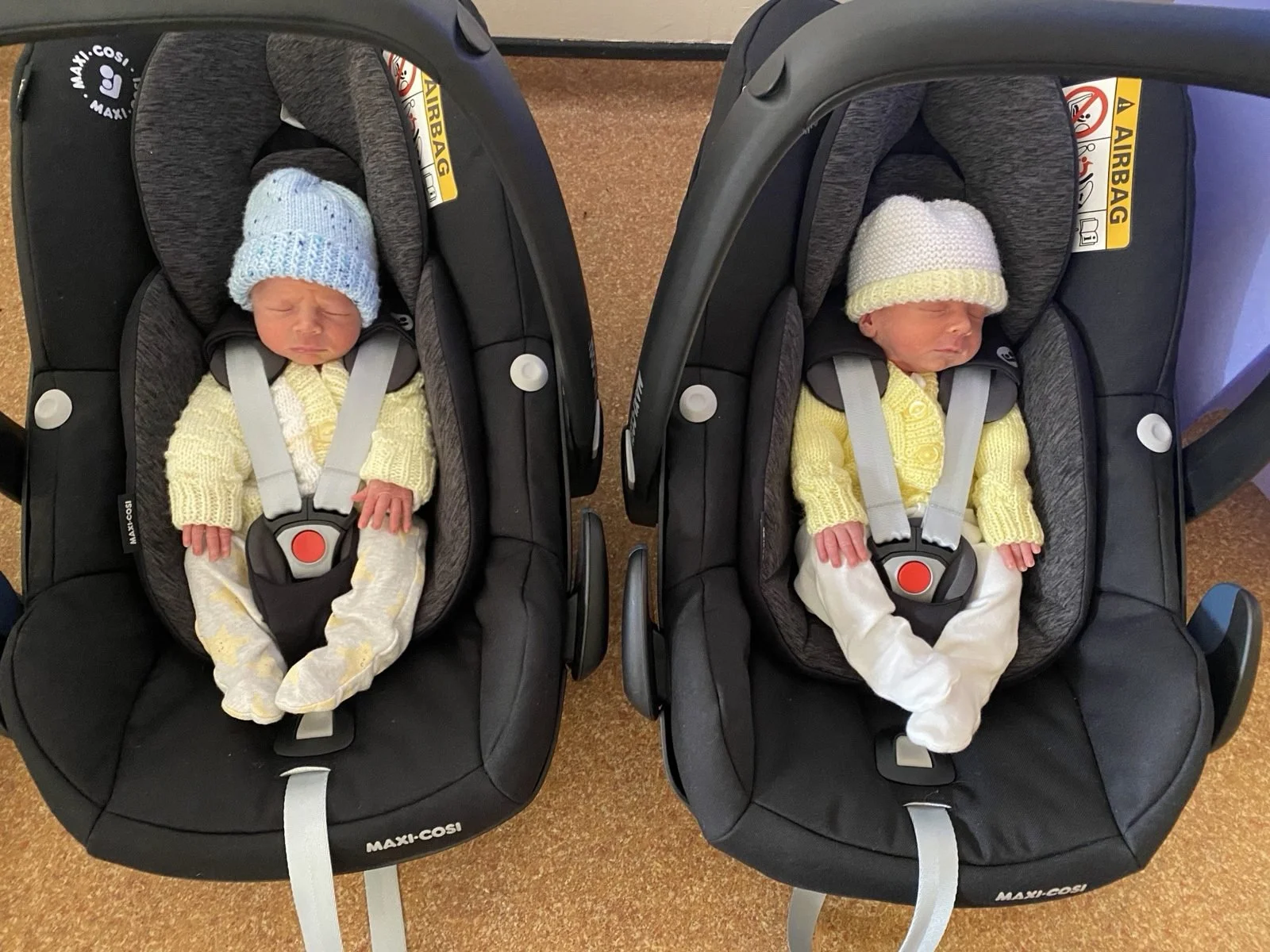
Seven days after my boys were born, we finally left the hospital. I’d been in for around ten days in all, and most of it is a blur. My mum helped me carry them out in their car seats. I still couldn't walk properly. My Dad had to carry me up the stairs when we got home.
The short version
The first weeks are about feeding, weight and warmth. Tracking every feed helped me stay on top of it.
If you're expressing, night sessions protect your milk supply for two.
Not feeling joy straight away is common. If low mood lasts, talk to your GP or health visitor.
I want to be honest about what came next — because nobody was honest with me.
That First Moment
Before we even got home, there was the moment the midwife came into my hospital room and announced I had a delivery. She proceeded to wheel the twins in while I still had a catheter in. The panic that went through me in that moment — I wasn't ready. I hadn't imagined it like that. Nobody had prepared me for the gap between the birth experience you picture and the reality of what actually happens.
That gap is real. And it's okay to name it.
Coming Home
I was petrified. I wouldn't let the boys out of the nursery for a month.
Because they were premature, they couldn't regulate their own body temperature — so I was constantly checking, constantly worrying, constantly making sure they were warm enough. The health visitor visits felt like inspections. Every weigh-in carried enormous weight — literally. If the boys lost weight they would be readmitted to hospital. That single fact hung over every feed like a threat.
The Feeding Reality
I did what any exhausted, terrified person alone with two premature babies would do — I built a spreadsheet. Every feed recorded. Every weight tracked.
I was expressing every 90 minutes. The boys were on a 2-3 hourly feeding cycle. And here’s what nobody tells you: with twins, nobody sleeps through the night, whether you’re expressing or not. If you are expressing, the night sessions matter. Prolactin, the hormone that drives milk supply, is higher at night, so skipping them can affect your supply for two.
I remember falling asleep with the pump still attached and waking up drenched. That is the unglamourised reality of feeding premature twins alone.
There was no break. There was no shift handover. There was just me, two tiny babies, a breast pump, and a spreadsheet.
The tracker I wish I’d had
I’ve turned my spreadsheet into something you can use. One log for both twins, side by side: feeds, expressing, nappies and weight, with daily totals that work themselves out. There’s also a one-page chart to print and stick on the fridge, for the nights when a spreadsheet is too much.
Download the feeding tracker (Excel)
Download the printable feeding chart (PDF)
Both are free. They’re a record of what happened, not medical advice: your midwife, health visitor or GP will tell you how much and how often your babies should feed.
The Postnatal Depression
I developed postnatal depression, and it was severe.
What finally helped was being completely honest with my GP and getting treatment.
I've written about my full experience on the dedicated PND & Mental Health page — including the neuroscience behind why twin mums are at higher risk, what PND actually feels like from the inside, and where to get help. If you're struggling, please go there now.
If you need support right now, the helplines are at the bottom of this page.
The Thing I Wish Someone Had Said
There was no joy. Not yet.
And that is okay.
I felt guilty for a long time about admitting that. You're supposed to be overwhelmed with love and gratitude. And the love was there — fiercely, completely. But joy? Joy requires headspace. Joy requires sleep. Joy requires feeling safe. I had none of those things.
If you're in those early weeks and you're just surviving — you are not failing. You are doing something extraordinarily hard. The joy comes. It just doesn't always come straight away, and nobody should make you feel like it should.
What I Know Now That I Wish I'd Known Then
— Accept every single offer of help — without guilt
— The spreadsheet is stressful but it genuinely helps — keep tracking
— If you’re expressing, try not to skip the night sessions — they protect your supply
— Your recovery from major surgery matters too. People kept telling me “you can’t pour from an empty cup”, and it made my blood boil: what other choice did I have? Let anyone who offers hold the babies, and lie down
— The weight anxiety is real, but mine did gain. Your midwife or health visitor will tell you if they’re worried
— You are allowed to feel overwhelmed, terrified, and not yet joyful
— Tell your GP or health visitor honestly how you are feeling — don't perform wellness when you're not well
— If medication is suggested — please consider it with an open mind. It changed everything for me
If You're Really Struggling
Please talk to someone. Not tomorrow. Now.
— Your GP or health visitor — always your first port of call
— PANDAS Foundation — perinatal mental health support: WhatsApp support (Mon–Fri, 9am–5pm) or book a free call back at pandasfoundation.org.uk
— Samaritans — 116 123 — free, 24 hours, UK-wide, completely confidential
— Twins Trust Twinline — 0800 138 0509 — free helpline just for twin and triplet families (opening hours at twinstrust.org)
You do not have to carry this alone. I promise you, you do not.
— Rebekah
Next in my story: the twin sleep journey.