
Twin Pregnancy — What Nobody Tells You
The short version
Twin pregnancy is harder on your body: stronger sickness, more swelling, and constipation that can become a medical issue. Tell your midwife early.
Around 60% of twins arrive early, so prepare sooner and know that a stay in NICU is common.
Shock and fear are normal. If you're struggling, tell your midwife or GP now, not after the birth.
Finding Out
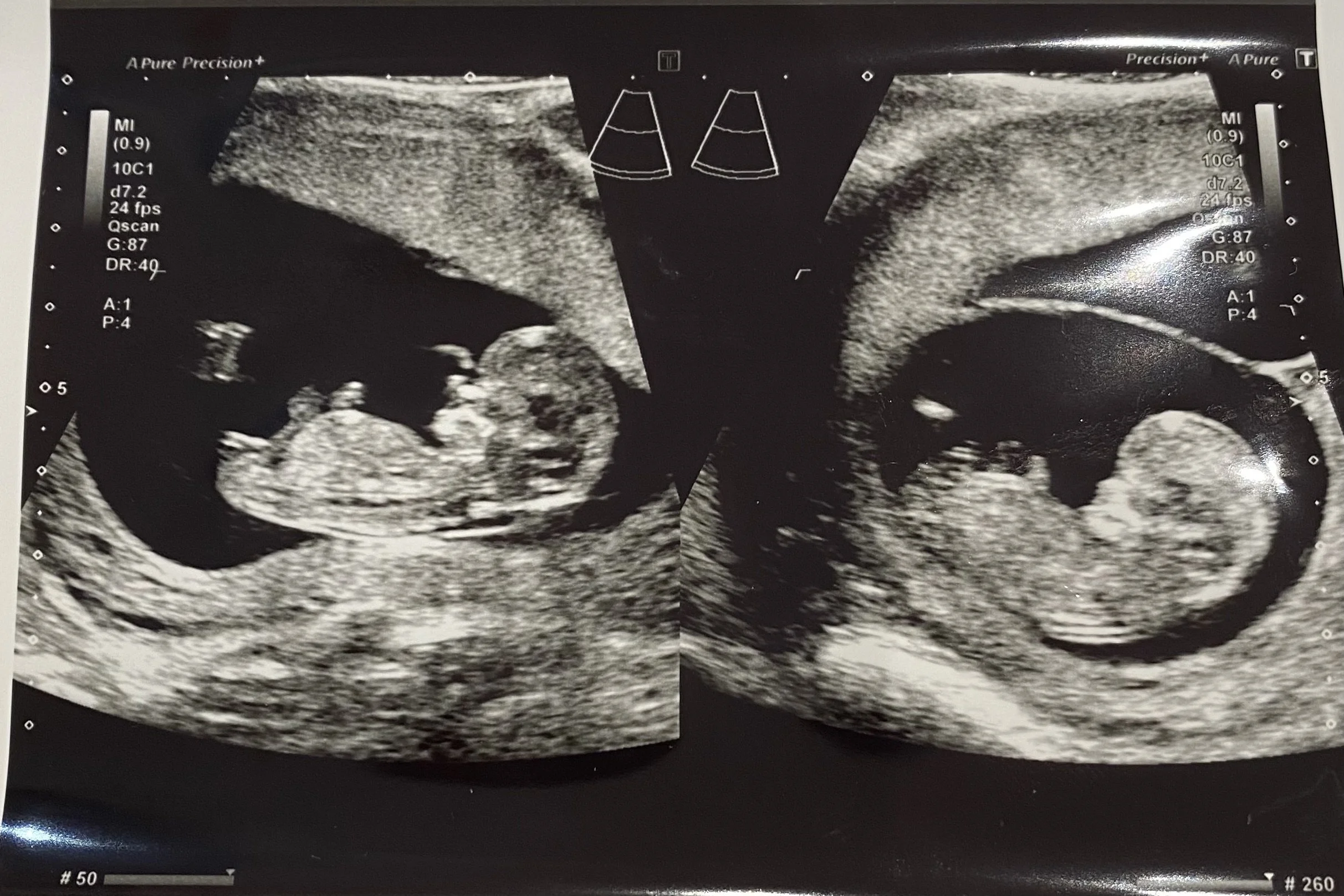
I found out I was expecting twins at six weeks.
I had gone for an early scan because the sickness was so severe I knew something was different. In hindsight there were signs — an unusually strong positive pregnancy test far earlier than it should have worked, and sickness that was relentless from the start. One of the signs of twins is extreme early pregnancy sickness. Nobody told me that.
The sonographer warned me she probably wouldn't be able to see anything externally at six weeks and might need to do an internal scan. On the external scan she could see two. But she couldn't rule out a third.
I was trembling. No words. Just utter panic.
She performed the internal scan and ruled out a third. I took a slight breath. I was still petrified.
The Financial Reality
And then, almost immediately, the practical reality hit.
We plan for one. We save for one. We buy for one. The moment you find out you're having twins, every financial assumption you've ever made goes out of the window. Two cots. Two prams. Two car seats. Two of everything — all at once, not spread across years like singleton parents.
And then there's the maternity leave. One pregnancy. One period of leave. Two babies to care for. The financial pressure on twin mums is enormous and almost entirely invisible in mainstream parenting conversations.
If you're sitting in that scan room right now in shock — financially and emotionally — that feeling is completely valid. You're not being ungrateful. You're being human.
What Happens To Your Brain
Before we go any further — something important that nobody told me and that I wish they had.
Pregnancy physically changes your brain. This is not a metaphor. It is neuroscience.
In 2024, researchers writing in Nature Neuroscience followed one woman’s brain through her whole pregnancy and found widespread changes in grey and white matter. Hormones like oestrogen rise to many times their usual level during pregnancy, then fall sharply after the birth. That hormonal cliff edge is staggering, and it can affect your mood, your memory and how you think.
Many women notice changes in how they think during pregnancy and after the birth: brain fog, memory lapses, feeling unlike yourself. This is common, and it isn’t you failing. Your brain is adapting to becoming a mum.
But here is what this also means: your PND, if you experience it, is not weakness. It is not failure. Hormones and the changes in your brain play a real part. And for twin mums, dealing with all of this with two babies, often premature, research suggests the risk of postnatal depression is higher.
You are not broken. Your brain went through something extraordinary.
Doing It Alone
At five months pregnant, he left. Ten years in a relationship, married and without children, and suddenly I was going to be on my own with two.
Carrying twins with a broken heart is one of the hardest things I have ever done.
From then on, every appointment, every scan and every consultant visit came with the same question: how on earth was I going to do this?
If you are navigating twin pregnancy without the support you expected — whether that's a partner who has left, a relationship that has broken down, or simply feeling unsupported — I see you. And I want you to know it is possible to get through it. Even when it really doesn't feel like it.
The Physical Reality
From around 16 weeks I was deeply uncomfortable in ways I hadn't anticipated. Nobody had warned me how physically brutal carrying two babies would be.
The swelling was relentless. The sickness was brutal — driven by hormone levels that are significantly higher in twin pregnancies than singleton ones. There were moments where I genuinely felt like I couldn't breathe — two babies taking up space that one body was never designed to share.
And then there was the constipation.
I say this plainly because nobody warned me and they should have. Twin pregnancy constipation is not ordinary constipation. It is a specific, prolonged, at times genuinely frightening experience. It was, without exaggeration, more painful than my c-section. At one point it was so severe that I fainted. On reflection — and only on reflection — there is a dark comedy to fainting whilst pregnant with twins due to constipation. At the time it was not funny at all.
Practical advice on constipation:
— Tell your midwife early — there are safe medications they can prescribe
— Stay hydrated — more than you think you need to
— Gentle movement where possible
— High fibre foods from the start
— Don't suffer in silence — it can become a medical issue if left unaddressed
At six months I developed a kidney stone on my right side. It was frightening. What I didn't find out until we were safely through it was that my consultant had privately feared I might not make it past 24 weeks, because of the stress I was under after my husband left. I couldn’t eat. I could barely function. The reality is that the toll it took on my body could have cost me my life, and theirs. When I did make it past 24 weeks, he told me — only then — that he could now breathe, and was confident he could save them if needed.
The fact that he withheld that fear until we were through the danger zone was, I think, an act of kindness. But it does give you a sense of what twin pregnancy can involve that nobody prepares you for.
What I wish I'd known — and done earlier:
— Buy a pregnancy support belt from the start
— Stretch every single night
— Elevate your legs whenever you can
— Book pregnancy massages earlier than you think you need them
— Tell your midwife about constipation immediately — don't wait
— Accept that it's going to be really tough — being mentally prepared matters
I was always caught by surprise. I'd have coped better knowing what was coming.
The Silver Linings
But then — those kicks. Seeing four arms and four legs moving on a scan. Realising you have three heartbeats and six lungs inside you at once. That is genuinely extraordinary.
Two faces. Two sets of features. Two tiny humans growing together. However hard the pregnancy was, those moments took my breath away in the best possible way.
The Birth
I had a planned c-section. What I got was very different.
My boys were born during the week of NHS strikes. There weren't enough staff for the planned procedure. So they induced me instead: labour, then two and a half hours of pushing, before an emergency c-section.
You hear about the tea and toast after the birth: a cuppa, a slice of toast, your babies on your chest. That was far from my reality. I woke up not knowing what had happened, screaming, with no babies beside me. It was only when I noticed the woman in the bed opposite holding her baby that I realised I must have had my boys.
That experience shook me to my core. I want to say that plainly because too many women are told to feel grateful their babies arrived safely — and of course I am, deeply. But both things can be true. The outcome can be wonderful and the experience can still be traumatic.
When I finally got home I just kept thinking — what else bad is going to happen?
If you had a difficult birth experience, you are allowed to name it. You are allowed to grieve it. And you are allowed to ask for support to process it.
If you are struggling with birth trauma, please speak to your GP or midwife. You deserve support.
34 Weeks — and NICU
My boys were born at 34 weeks. Premature, like so many twins. They spent 24 hours in NICU on CPAP support before coming to me. Twenty-four hours that were terrifying and extraordinary in equal measure.
In that NICU ward I met other mums. Mums whose babies were much smaller, much more fragile, fighting much bigger battles. I mostly just listened. I didn't have words that felt adequate — because there aren't any. But I sat with them. And I want to say something to any mum who has spent time in NICU, whether for 24 hours or 24 weeks:
What you go through in there is something only you truly understand. And you are stronger than you will ever fully realise.
A Note On Postnatal Depression
I developed postnatal depression after my boys were born. I want to name it here because the seeds of it were sown during pregnancy — in the trauma, the isolation, the physical and emotional battering that twin pregnancy can be.
If you are already struggling during pregnancy — with anxiety, with darkness, with feeling completely alone — please tell your midwife or GP. You don't have to wait until after the birth to ask for help.
I've written about my experience of PND in full on the dedicated PND & Mental Health page — including what it actually felt like, what helped, and where to turn. If any part of this page has resonated with you, please read it.
If You're Currently Pregnant with Twins
You are about to do something remarkable. It will be harder than you expect. It will also be more extraordinary than you can imagine.
Prepare your body. Prepare your mind. Accept every offer of help. And know that whatever you're feeling right now — the fear, the disbelief, the "I can't do this" moments — every single one of those feelings is valid.
You can do this. Even on the days it really doesn't feel like it.
And if you're doing it alone — really alone — please know that TwinSprout exists because of you. You are not invisible here.
What happened after they arrived deserves its own page. Because nobody warned me about that either.
This page is my personal experience, not medical advice. Every twin pregnancy is different, so please talk to your midwife, GP or consultant about any symptoms, and if you're worried about yourself or your babies, call your maternity unit straight away, or 999 in an emergency.
— Rebekah